Category Archives: ACEWATER III

NUST Zimbabwe visist UNESCO offices in Harare, 9 October 2025

The NUST Zimbabwe team for the ACEWATER III project visited the UNESCO regional offices in Harare, where areas of possible collaboration were discussed. The NUST Zimbabwe team will assist UNESCO in selected projects in the Binga area, as implementing partners, particularly for groundwater monitoring and early warning system designs.

NUST Zimbabwe attends the International Symposium on Heavy Metal Pollution, in collaboration with the Japan International Cooperation Agency and the ZAZINAMBO project 7-8 October 2025

Five members from NUST Zimbabwe ACEWATER III team attended a two-day International Symposium on Heavy Metal Pollution at the University of Zimbabwe, courtesy of the Japan International Cooperation Agency and the ZAZINAMBO project. The team presented posters on the current work being done on the Deka River, as well as one oral presentation.

14th AMCOW General Assembly adopts the Africa Water Vision 2063 and Policy

The 14th Ordinary Session of the Governing Council of AMCOW, which held on 29 September 2025 in Dakar, the Republic of Senegal, adopted the Africa Water Vision 2063 and Policy. Together, we are building a water secure and resilient Africa with safe sanitation for all.

Read more: 14th AMCOW General Assembly adopts the Africa Water Vision 2063 and Policy

The Vision and Policy positions water as a catalyst for achieving Africa Union’s Agenda 2063’s goals: from poverty eradication, food security and industrialisation to climate resilience and regional integration.

In addition, the Governing Council of AMCOW:

  • Acknowledged the opportunity – presented by the theme of the Union for 2026 – to influence the political agenda of the African Union. The need could not be overemphasised to make the water sector’s return to the Union’s agenda – after 18 years – impactful, and one of lasting change.
  • Expressed unequivocal support for the Strategic Programme on Groundwater for Water Security and Resilience in Africa, urged immediate action to initiate implementation, and
  • Also agreed to strengthen AMCOW’s financial sustainability and impact through increased Member States contributions; timely remittance of contributions; and all Member States honouring financial obligations to AMCOW

Please find the Communique on the Adoption of the Africa Water Vision 2063 and Policy and launch of its implementation in English, French, Portuguese, and Spanish.

Click to read >> ENFR | PT | SP    

Exploring TVET and Industry Collaboration in the Water Sector in Botswana

On 4 September 2025, a collaborative workshop between two European Union-funded projects took place at the University of Botswana in Gaborone. Team members from the projects, ACEWATER III (implemented through the AUDA-NEPAD Networks of Water Centres of Excellence and the Platform of Vocational Excellence Water, met with staff members of the University of Botswana as well as TVET Colleges in the region.

The objectives of the workshop were to:

Continue reading

Seminar/Webinar: The Development of a regional maximum flood map for Malawi. 19 September 2025, 14:00 CAT

As part of a bi-monthly seminar series, Professor Cosmo Ngongondo from the University of Malawi’s School of Natural and Applied Sciences, will host a seminar with Professor Kobus du Plessis from Stellenbosch University, who will discuss the development of a Regional Maximum Flood Map for Malawi.

The seminar will take place on 19 September 2025 at 14:00 Central Africa Time (CAT), and participants can join online. Pre-registration is a requirement.

To register, click here

The research and capacity development activities are undertaken within the framework of the ACEWATER III project, which is funded by the European Commission.
Zambezi Watercourse aquifer systems: State of knowledge and future research

In this presentation, Prof Kawawa Banada from the University of Zambia shares information on the state of knowledge and future research within aquifer systems within the Zambezi Watercourse in Southern Africa.

Information relates to:

  1. The Zambezi River Basin Overview;
  2. Key Environmental and social Challenges (not exhaustive);
  3. How much water is available in the Zambezi Basin?
  4. Water allocation at Basin level (Based on WA+ 2003-2023)
  5. Changes in forest cover and restoration potential
  6. What do you know about the aquifers?

In summary:

Continue reading

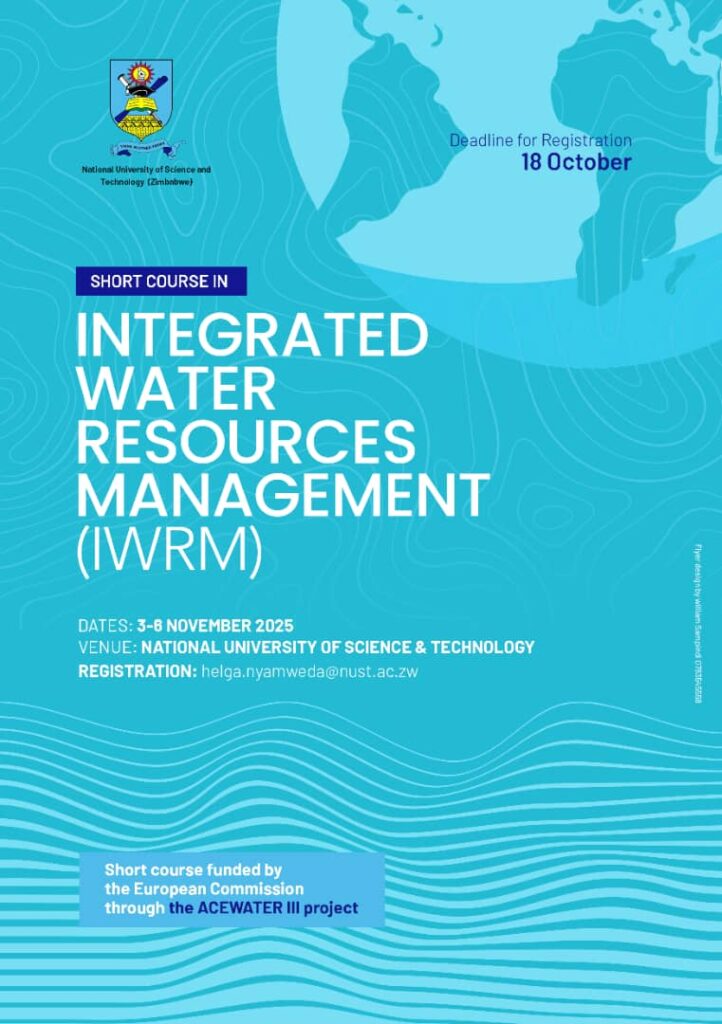
REGISTER NOW!: Short Course in Integrated Water Resource Management – Bulawayo, Zimbabwe, 3-6 November 2025

This short course introduces the principles and practice of Integrated Water Resources Management (IWRM) as a holistic and participatory approach to managing water resources in a sustainable, equitable, and efficient manner. Furthermore, it emphasises cross-sectoral coordination, stakeholder engagement, policy and institutional frameworks, and adaptive strategies for addressing water-related challenges, particularly under conditions of climate variability and socio-economic change.

TARGET AUDIENCE:
Municipality workers, engineers, water utility staff, urban planners, environmental officers, local government leaders, community development professionals, extension officers, and policymakers. researchers, students.

VENUE:
National University of Science and Technology (Zimbabwe)

COURSE OBJECTIVES:
By the end of this course, participants will be able to:

• Explain the core principles, objectives, and significance of Integrated Water Resources Management (IWRM).
• Analyse and manage water resources using a holistic, multi-sectoral and sustainability-focused approach.
• Apply IWRM frameworks and tools in municipal planning, policy formulation and service delivery systems.
• Identify and propose solutions to key urban water challenges, including scarcity, pollution, and equity concerns.

TO REGISTER:
Email Helga Nyamweda helga.nyamweda@nust.ac.zw
+263 77 239 6785

MORE ABOUT THE COURSE:

The research and capacity development activities are undertaken within the framework of the ACEWATER III project, which is funded by the European Commission.

Short course trainings at Addis Ababa University (Institute of Water Environment and Climate Research) on Emergency WASH and Earth Observation for Transboundary Water Resources Management

The Institute of Water Environment and Climate Research at Addis Ababa University offered two short course trainings in August 2025. The first training was on Emergency Wash from 19-22 August 2025 aimed at professionals managing disasters who needed critical skills to design, coordinate and evaluate life-saving WASH interventions during disasters. This course had 30 in-person and 55 virtual trainees.

The second course was hosted from 25-29 August 2025 on Earth Observation for Transboundary Water Resources Management, which attracted 30 in-person and over 30 virtual participants together, including those from ACEWATER III partner institutions.

The research and capacity development activities are undertaken within the framework of the ACEWATER III project, which is funded by the European Commission.