
The WASA (Water Security in Africa) programme has launched a webinar series to address critical water challenges in Sub-Saharan Africa. Running from March 2026 to November 2027, the initiative bridges knowledge gaps, promotes innovative solutions, and builds a regional community of practice among water professionals, researchers, policymakers, and practitioners through joint learning. For more information about the WASA project and this webinar series, please follow this link: https://www.watersecurityafrica.org/event/wasa-webinar/.
This first edition of the WASA Webinar Series took place online on 25th of March and was attended by 35 participants. Speakers for the first webinar included:
Prof Kawawa Banda (University of Zambia) (SeeKaquA Project) – “Investigating deep sitting fresh water aquifers within a saline environment: A case study of the Machile-Zambezi Basin.”
Dr Anna Matros-Goreses (NUST) (Namibia) (WaMiSAR project) – “WASH Innovation – From Sensors to Solutions: Exploring Technology Transfer Potential in the Cuvelai Basin.”
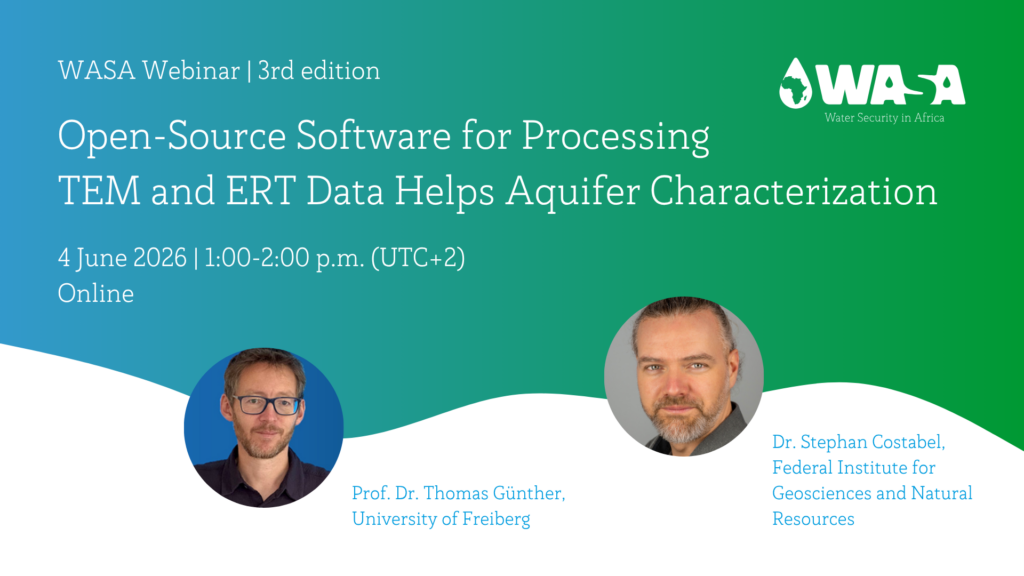
The third WASA webiner took place on 4 June. This edition already experienced an increase in participation, as 47 colleagues from WASA, PERIPERI U and SANWATCE joining. Guest speakers from the SeeKaquA project presented on: Open-source software for processing TEM and ERT data for aquifer characterization. Speakers were Prof. Dr. Thomas Günther, University of Freiberg, Germany and Dr. Stephan Costabel, Federal Institute for Geosciences and Natural Resources, Germany.